
What Georgia GBI / GCIC Is
The Georgia Crime Information Center is a division of the independent Georgia Bureau of Investigation. Authority in O.C.G.A. Title 35, Chapter 3, Article 2 makes GCIC the state repository and Georgia’s connection to criminal-justice information networks. Its Computerized Criminal History system stores reported identity, arrest, court-disposition, and Georgia custodial data. GBI says that file holds records on almost four million offenders.
Georgia GCIC does much more than sell a public result. Identification Services handles fingerprints through biometric systems. The Georgia CJIS Network serves authorized justice agencies. GCIC supports GAPS, UCR reporting from more than 600 Georgia agencies, the state sex offender registry, protective orders, Rapid ID, wanted and missing person files, and links to FBI systems. Each Georgia product has its own access rules. A public felony search is not the whole CCH file.
Georgia GBI / GCIC History
Georgia’s central record system grew from a fragmented network. A 1971 study committee found that isolated local records and the GBI fingerprint bureau were not enough. A June 1972 master plan called for one computerized statewide authority and required local justice agencies to report fingerprints and outcomes. GCIC began by executive order in 1972 within the Department of Public Safety. The 1973 reorganization made GBI independent and kept GCIC as its information-center division.
The Georgia technical path continued from paper prints to CCH terminals, UCR reporting, AFIS in 1990, electronic livescan, disposition exchange, GAPS, public search products, and Rapid ID in 2010. In August 2025, the Multimodal Biometric Identification System replaced AFIS. Better Georgia tools improved identity links and speed. They did not move ownership of the original arrest report or court pleading away from the county.
Note: Georgia's repository technology changed over time, but county agencies still own the original arrest reports and court files.
Georgia GBI / GCIC Criminal History Check Options
Choose the official product by the question being asked. Georgia Felon Search lets any requester look for final public Georgia felony convictions by demographic data. It omits misdemeanors, juvenile history, pending matters, restricted records, federal cases, and other states. A personal history obtained by the subject through a local sheriff or police department is broader. A fingerprint-supported GCIC inspection is the sound route when identity or accuracy is in dispute. GAPS serves authorized programs and sends its response to the requesting agency.
| Product | Who May Order | What It Returns | Current Cost |
|---|---|---|---|
| Georgia Felon Search | Any requester | Possible name matches and public final Georgia felony convictions | $15 per search or rap sheet viewed |
| Own Georgia history | The record subject through local procedure | Georgia adult history available to that person | Local fee varies |
| GAPS Georgia-only fingerprints | Authorized program or agency | Fingerprint-matched Georgia response to the authorized agency | $39.99 standard; $37.99 qualifying volunteer |
| GAPS Georgia and FBI | Authorized program where legally required | Georgia and national fingerprint response | $51.99 standard; $47.99 qualifying volunteer |
| GCIC inspection/challenge | The record subject | Personal review used to find an incomplete or inaccurate entry | $10 with cards; $25 with GBI fingerprinting |
| Record restriction | An eligible record subject | Restriction processing after required source-agency action | $25 where applicable |
These Georgia amounts come from the GCIC schedule effective January 1, 2025. Georgia county copy, fingerprint-card, and notarization fees remain local.
Note: A Georgia GAPS response goes to the authorized agency, while personal record review follows a separate local or GCIC route.
GCIC CCH Versus Felon Search
The internal GCIC CCH is a compiled identification record. It can tie an arrest cycle to a reported disposition and custodial entry. Georgia Felon Search is a narrow public extract of final in-state felony convictions. The public portal requires first name, last name, birth date, and sex. Middle name, race, Social Security number, and another identifying number can narrow possible matches. The service charges even when no public record is returned.
A Georgia name match is not exact identity proof. The portal can show up to five close candidates, and its requester must judge whether one fits. Only fingerprint comparison establishes identity. A Georgia no-record response means no matching public felony entry in that product. It does not rule out an arrest, misdemeanor, pending case, restricted event, federal matter, another state, or a county disposition that has not reached GCIC.
Scope matters. Treat Georgia Felon Search as a final-felony query, not as a complete Georgia criminal history or a county court search.
How Records Reach Georgia GBI / GCIC
A Georgia criminal-history cycle begins at arrest and booking. A sheriff, police department, State Patrol post, campus agency, or another authorized unit submits reportable fingerprints and arrest data. A successful fingerprint submission creates an 11-digit Offender Tracking Number. Charge Tracking Numbers identify charge lines. Those keys allow later prosecutor and court reports to connect with the right arrest event.
Data flow: County Arrest › Fingerprint Submission › Georgia Bureau of Investigation / GCIC › Court Disposition Reporting › Rap Sheet
Georgia GCIC Rule 140-2-.03 calls for a fingerprintable arrest submission within 24 hours, with a weekend or holiday allowance, and the responsible agency’s final disposition within 30 days. Missing keys, old Georgia paper cases, name variations, and late reports can leave a result incomplete. GCIC audits users and maintains the compiled entry, but the source office must validate a correction.
Georgia GBI / GCIC GAPS Network
The Georgia Applicant Processing Service electronically captures fingerprints for authorized noncriminal-justice transactions. IdentoGO by IDEMIA has operated the Georgia channel since February 3, 2025. Enrollment begins with the exact service code supplied by the administering agency. The code determines routing and whether the transaction is Georgia-only or includes an FBI response.
The official Georgia GBI service overview shows how GAPS connects enrollment sites to GCIC.
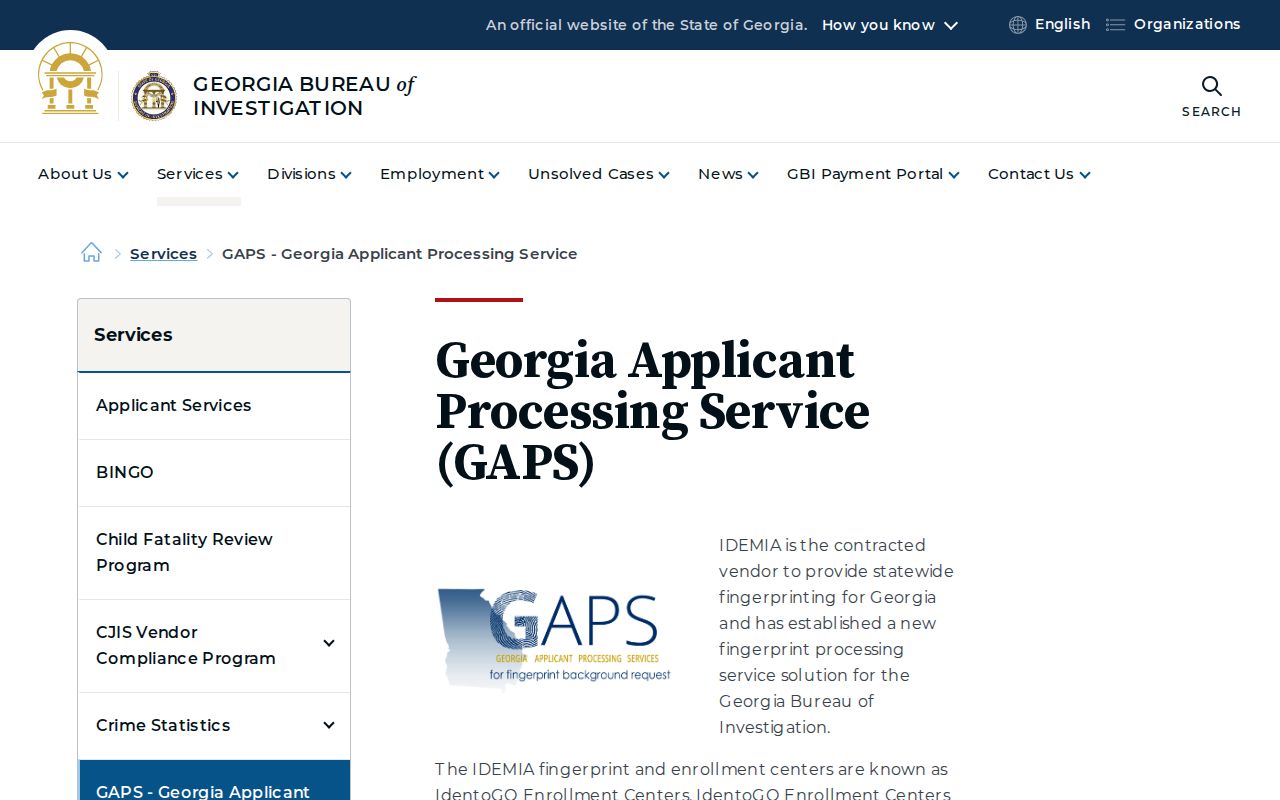
The Georgia network is designed so residents generally need not travel more than 25 to 30 miles. A person enrolls with the service code, books a site, brings acceptable ID, and submits prints. Georgia results usually reach the authorized agency within 24 to 48 hours. GAPS does not normally hand the person a readable rap sheet. Personal review uses the local agency or GCIC inspection route.
Ordering a Check From Georgia GBI / GCIC
There is no single order form for every GCIC purpose. A public final-felony question belongs in Georgia Felon Search. A subject seeking their own Georgia history starts with a sheriff or police records unit and follows that office’s identity process. An authorized fingerprint transaction starts with the program’s GAPS service code. An accuracy challenge uses fingerprint-supported inspection and source documents.
- Define whether the need is a public felony query, your own record review, or an authorized fingerprint transaction.
- Gather the matching identifiers, identity documents, fingerprint cards, or service code.
- Submit through Georgia Felon Search, the local agency, GAPS/IdentoGO, or GCIC’s appointment and mail channel.
- Pay the product’s current fee and keep the receipt, search inputs, and response.
- Pull the county court file when a GCIC summary needs a final order, docket, or case explanation.
The GBI criminal history access overview explains the public and personal routes.
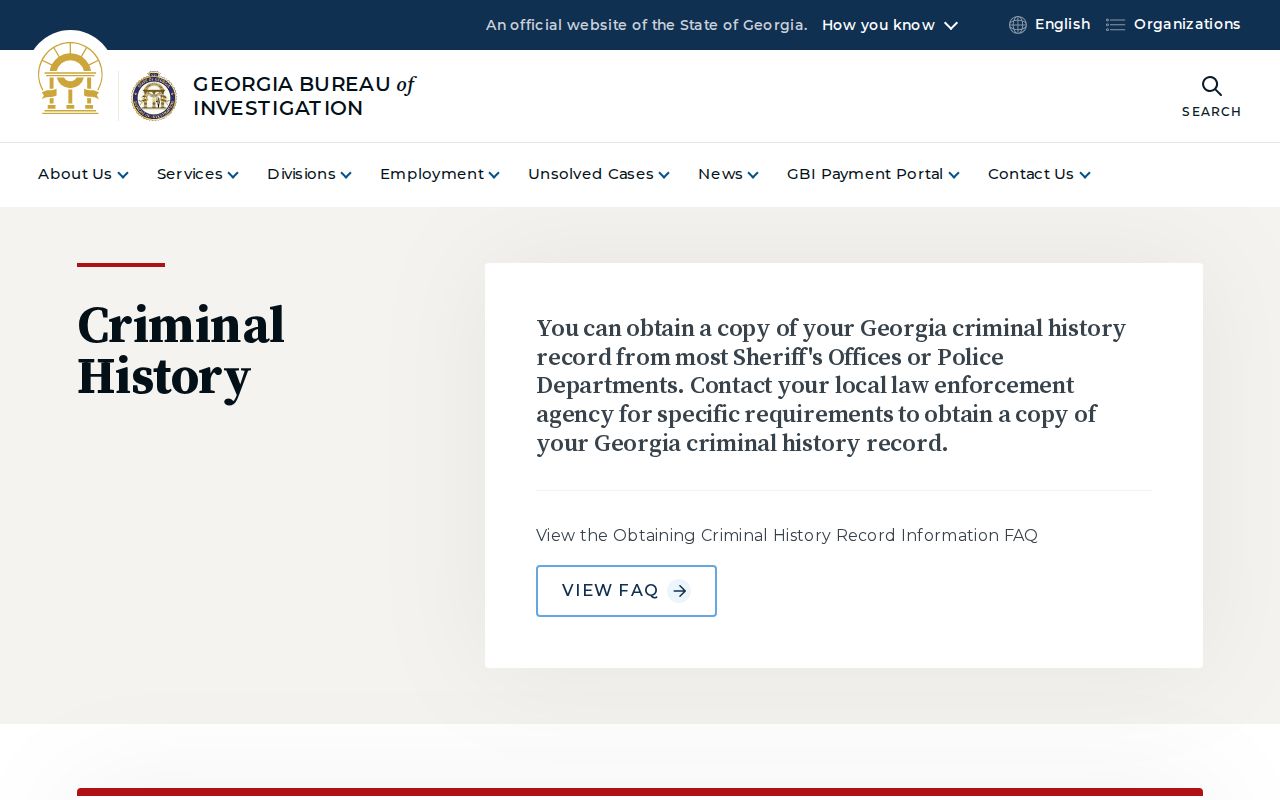
The Georgia access overview confirms that ordinary public name-based histories are handled through defined products and local agencies, not through an unrestricted GCIC help-desk search.
Why Georgia GCIC Outcomes Go Missing
Georgia GCIC can display only what contributors send and what identifiers can join. A Georgia county arrest may reach CCH before its dismissal, plea, acquittal, or sentence. A disposition can also fail to attach when an OTN is absent or wrong. The result may appear open even though the clerk’s docket is complete. That is a reporting gap, not proof that the prosecution is still pending.
Start with the county clerk or prosecutor that owns the official outcome. Ask that office to send a supported correction electronically. An arrest-data problem instead goes to the arresting or booking contributor. Georgia’s Criminal Data Exchange makes disposition reporting measurable, but it is not a person-search portal. The source-specific route prevents a county judgment from being sent to GCIC without the source office’s validation.
Note: GCIC compiles Georgia history, but it cannot invent or independently rewrite a county’s final court disposition.
County Records vs Georgia GBI / GCIC Checks
A GCIC history and a county file answer different questions. The Georgia repository provides a statewide, identification-linked summary. The clerk keeps the accusation or indictment, motions, hearing entries, plea or verdict, sentence, and available images. A sheriff holds booking and custody data. A Georgia local agency may therefore have fresher or richer facts than the compiled state history.
| Georgia GBI / GCIC Check | County Records | |
|---|---|---|
| Coverage | Reportable history received statewide | One county’s arrests, custody, and cases |
| Source | Fingerprint-linked CCH or limited public extract | Original reports, jail logs, dockets, and orders |
| Freshness | Depends on contributor submission | Updated as the local event or case moves |
| Detail | Summary arrest, disposition, and custody lines | Narratives, pleadings, docket events, and copies |
| Best use | Reviewing compiled Georgia history | Explaining and proving a specific event |
Use the directory of all 159 Georgia counties to find the local half of a record. The separate Georgia criminal court cases route helps locate the clerk and case source.
Note: A Georgia repository check and a county file complement each other; neither contains every field held by the other.
Georgia GBI / GCIC Record Restriction
Georgia calls its relief process record restriction. It limits ordinary noncriminal-justice dissemination of a qualifying arrest cycle; it does not erase every source record. Arrests before July 1, 2013 generally use the older agency, prosecutor, and GCIC application route. Later events are normally handled through the prosecutor. Court sealing is a separate step and can require an order from the court that owns the file.
The official GCIC record restriction instructions provide the current routes and pre-2013 form.
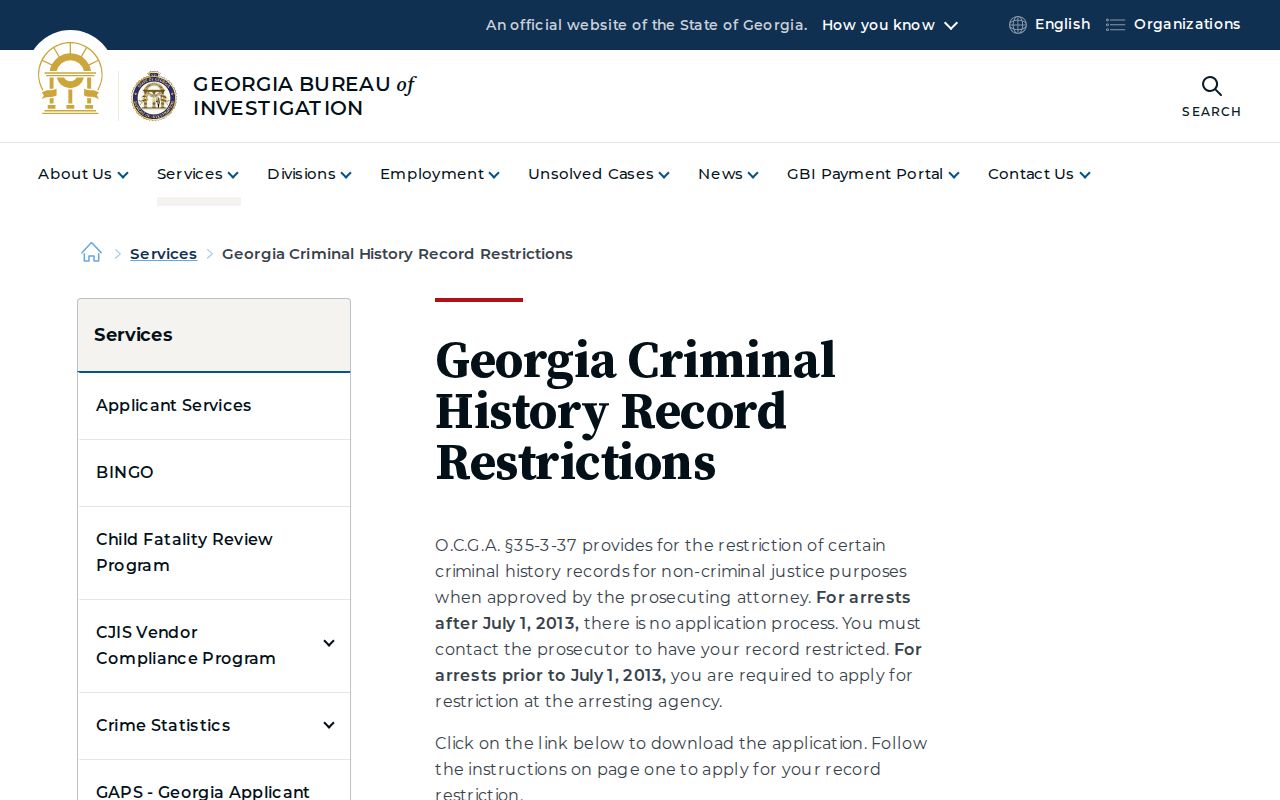
The instructions show why a restriction request must follow the arrest date and source-agency path. The $25 GCIC processing fee applies where specified by the current schedule. A person should review a fresh history after processing and separately confirm court sealing.
Georgia GCIC Personal Inspection
Personal inspection is meant for the subject of the record. A local sheriff or police department may provide a Georgia history under its own identity and fee procedure. GCIC also offers appointment-only lobby inspection and fingerprinting at 3121 Panthersville Road, Decatur, GA 30034. Call 404-244-2639, option 1. Same-day appointments are not available.
A mail challenge goes to GCIC CCH/Identification Services, P.O. Box 370808, Decatur, GA 30037-0808. Include a signed letter describing the issue and a return address, two completed applicant fingerprint cards, an ID copy, the printing agency’s contact details, and a certified check or money order for the current fee. Keep copies. Do not send cash.
The official GCIC criminal history FAQ provides inspection, attorney-request, First Offender, correction, and contact details.
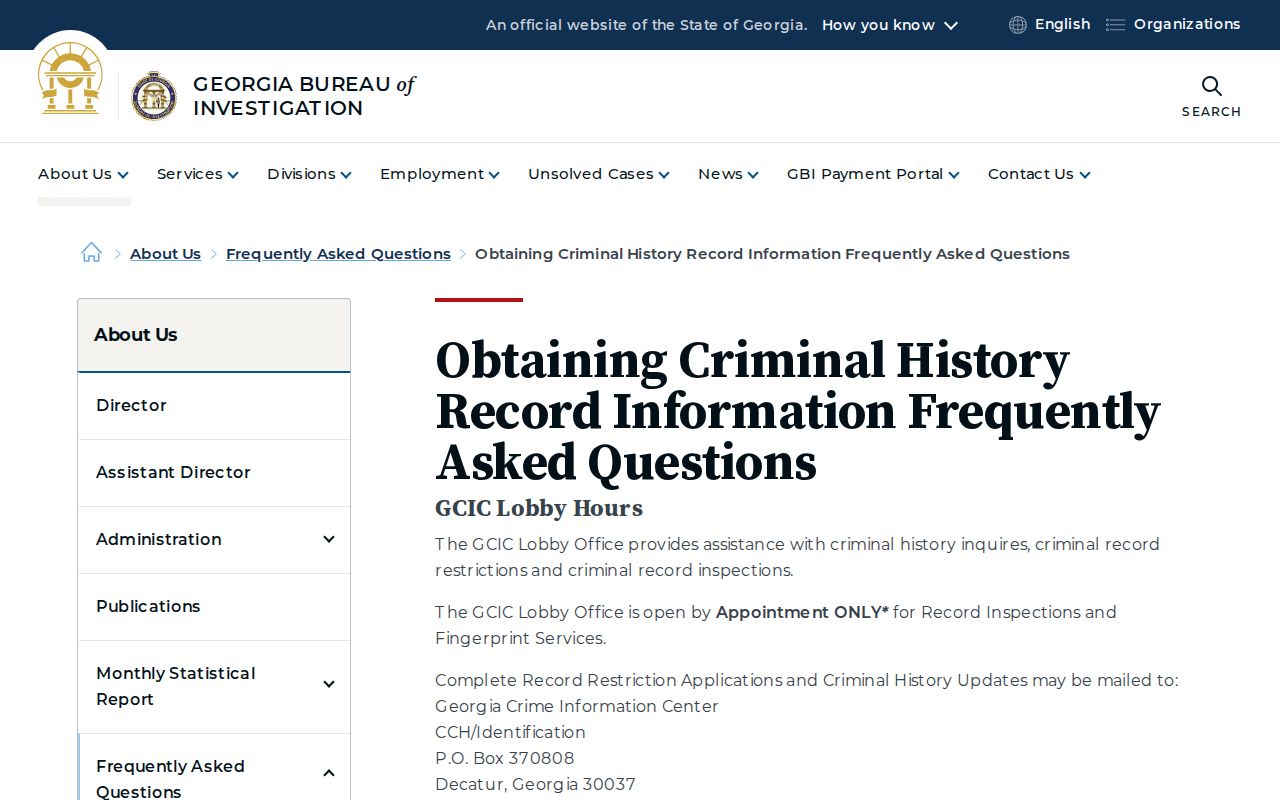
That FAQ is the practical reference when choosing between local inspection, headquarters service, and a supported update.
Fixing Errors in a Georgia GBI / GCIC Record
Correct the source first. Common problems include a missing disposition, an arrest tied to the wrong identity, an incorrect charge line, and an entry that should reflect restriction or First Offender treatment. Fingerprints resolve identity. The county docket proves the outcome. GCIC then updates the compiled record after the proper contributor supports the change.
- Obtain your own fingerprint-supported Georgia history through a local agency or GCIC inspection.
- Compare each arrest cycle, OTN, charge, and disposition with the county’s original court file.
- Ask the arresting agency to validate arrest data or the clerk/prosecutor to transmit the supported outcome.
- Send the required documentation to GCIC and confirm the correction on a new personal copy.
For mailed update support, include clear identity and event details such as full name, birth date, sex, race, arrest date or SID, OTN, and the exact change requested. GCIC’s job is to maintain the state history after the source validates its piece. It is not a substitute clerk.