
Criminal Court Cases in Georgia
Georgia divides criminal work among several trial courts. Superior Court exists in every county and has exclusive felony jurisdiction. State Court, where established, commonly hears misdemeanors and traffic cases. Magistrate Court issues warrants, holds first appearances, and handles preliminary matters. Municipal and Probate courts have narrower authority set by state and local law. The court name matters because one name search in the wrong system can miss the whole case.
Each Georgia clerk keeps the court's docket, pleadings, orders, and signed judgments. The Georgia Bureau of Investigation does not keep the original prosecution file. Georgia GCIC receives reportable arrest and disposition data for a compiled criminal history, but a Georgia criminal case file remains with the court that heard it. That split makes the Georgia clerk the key source for the exact charges, filings, and final order.
Georgia Court E-Access Limits
Georgia Courts E-Access is a gateway to participating courts and provider systems. It is not one complete Georgia criminal court case index. Coverage, backfile dates, document access, and charges vary by provider. An account is required after the gateway redirects a searcher. Courts not listed there still require a direct clerk search, and lower-court matters may sit in separate systems.
The official Georgia gateway shows why a statewide starting point can still lead back to a county. A Georgia provider's no-result screen proves only that its covered records did not return a match. It does not prove that no Georgia case exists. Search name variants, check the likely Georgia court class, and ask the clerk about paper archives or records outside the online date range.
The official E-Access source shows the participating-court gateway used for Georgia case access.
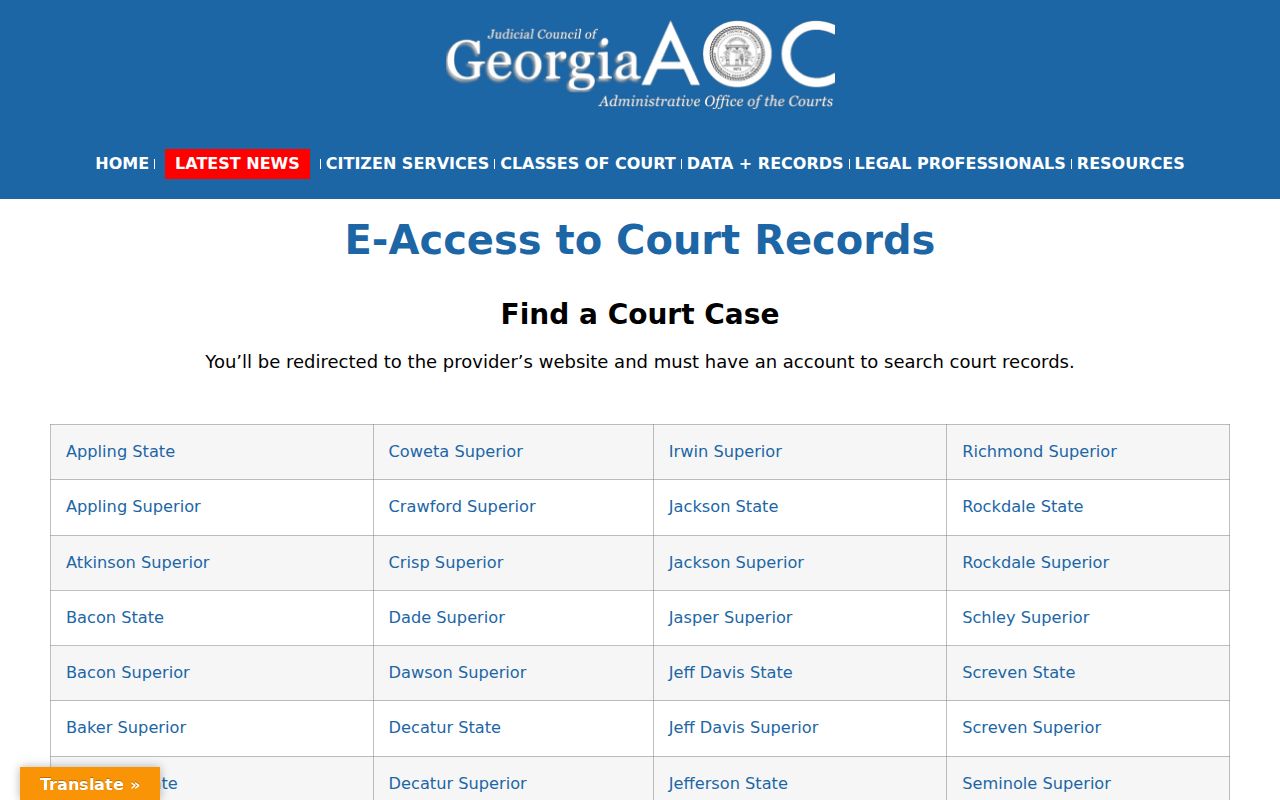
Its provider links reinforce that electronic access depends on the court and county selected.
Searching Georgia Courts E-Access to Court Records
Begin a Georgia case search with the county of arrest or charge and the level of court most likely to hold the file. A Georgia felony search usually starts in Superior Court. A misdemeanor may be in State Court, Municipal Court, Probate Court, or another Georgia court with lawful jurisdiction. Search the Georgia docket first, then obtain filed images or certified copies from the clerk.
- Open Georgia Courts E-Access and select a participating court or its linked provider.
- Create the required provider account, then search by case number or name variants.
- Narrow the query by court, criminal record type, filing dates, and available status fields.
- Read the full docket sequence and confirm the result for each charge.
- Ask the county clerk for missing images, archived files, or certified copies.
Georgia does not impose one universal county search form. The representative official form inspected in the research uses these controls. At least one criterion is required, and its coverage applies only to that court.
| Field Label | Type | Required | Notes |
|---|---|---|---|
| Case category | choice | Yes | Select Criminal Cases rather than Civil Cases |
| Last or company name | text | No | A phonetic option can expand a name search |
| First and middle name | text | No | Use variants when spelling is uncertain |
| DOB year | year | No | Shown for criminal searches in yyyy form |
| Filing date range | dates | No | Start and end dates can narrow common names |
| Case number | text | No | Use the court's exact local format |
Note: A provider may charge for document images even when its public Georgia case index can be searched without an image fee.
Choosing a Georgia Criminal Court
Court level is a search filter, not a minor detail. Superior Court is the Georgia felony anchor. State Court often handles misdemeanors and traffic matters, but it does not exist in every county. Magistrate Court records may show a warrant, first appearance, commitment hearing, or bond event before a felony reaches Superior Court. Municipal and Probate courts can hold ordinance, traffic, and limited misdemeanor files.
Georgia appeals add another layer. The Court of Appeals of Georgia reviews most appeal categories, while the Supreme Court of Georgia handles designated and constitutional matters. The Georgia appellate file may show briefs and an opinion, but it does not replace the trial court's full record. Follow the Georgia trial case number and notice of appeal to connect both files.
Timing also guides a Georgia court search. After arrest, a first appearance may occur before the prosecutor selects the final charges. An early Magistrate Court entry can therefore use a different label from the later Superior Court indictment. Search both stages when a felony docket seems incomplete. For misdemeanor records, confirm whether that county uses State Court or assigns the matter elsewhere.
Note: Georgia has 49 judicial circuits, but the original criminal case records remain tied to the filing county and court.
Inside a Georgia Criminal Case File
A Georgia docket is a timeline. It may identify the parties and lawyers, list each charge and Georgia code section, and show hearings, motions, pleas, and orders. Some Georgia entries have no public image attached. The Georgia clerk can quote copy costs and explain how to obtain a certified record. Sensitive identifiers, protected victim or minor information, juvenile matters, and sealed material can be withheld or redacted.
| Case Number & Court | Links the file to its Georgia court, division, filing date, and judge. |
|---|---|
| Charging Documents | May include an accusation, indictment, warrant return, and count-level statutes. |
| Docket Entries | Track filings, motions, hearings, pleas, continuances, and appeal notices. |
| Hearing Dates | Show scheduled and completed events, subject to later changes. |
| Disposition | States the outcome of each count, not merely whether the file is closed. |
| Sentence & Judgment | The signed order controls over a brief online summary field. |
The official representative court search illustrates the fields available in one Georgia county system.
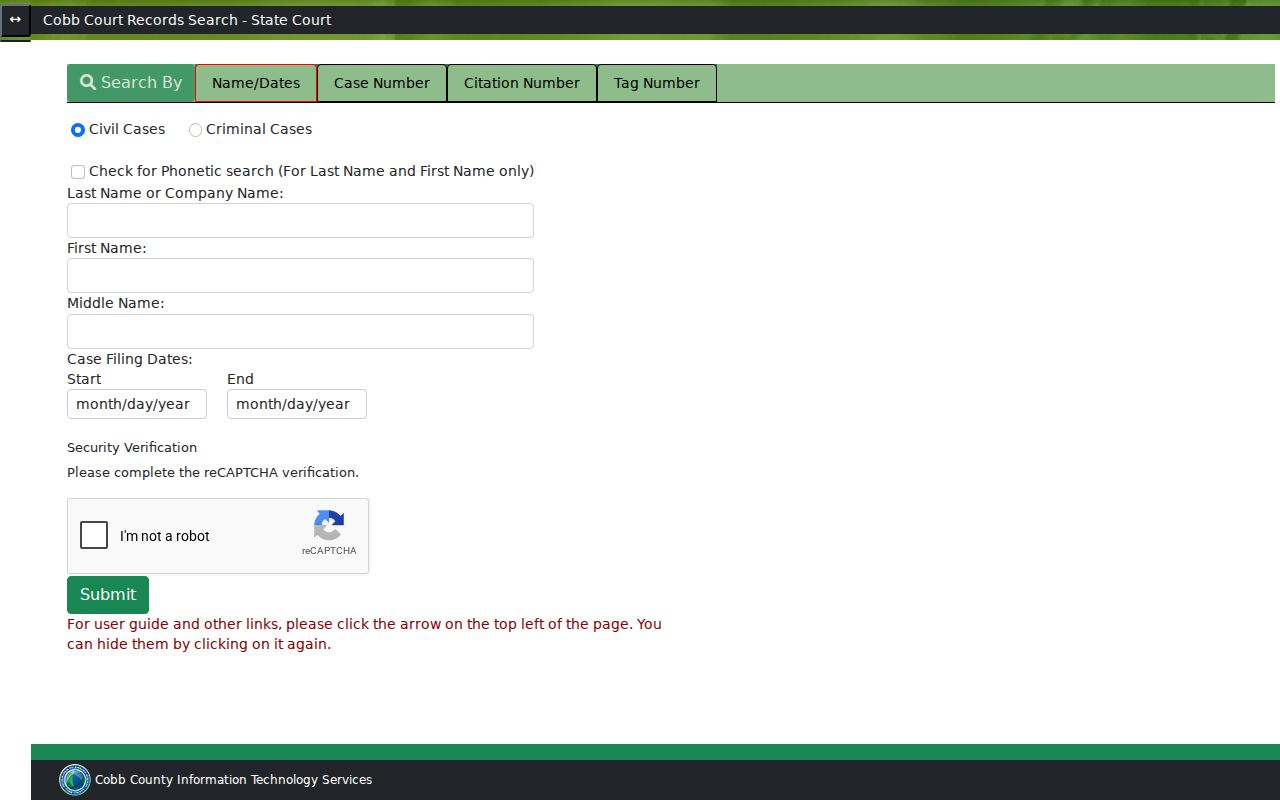
That example is useful for field recognition, but its misdemeanor and traffic coverage is not statewide.
Reading Georgia Case Dispositions
“Closed” is a Georgia administrative case status, not a verdict. Read the Georgia outcome beside every count. A guilty plea or verdict is a conviction. An acquittal is a not-guilty result. A Georgia dismissal ends a charge without conviction. Nolle prosequi means the prosecutor chose not to proceed. A dead docket places a Georgia prosecution on an inactive docket without a conventional judgment on the merits.
- Accusation
- A prosecutor's formal charging paper, often used for misdemeanors or when indictment is waived or not required.
- Indictment
- A formal felony charge returned by a grand jury after a true bill.
- No-bill
- A grand jury decision not to indict the charge presented.
- First Offender
- A Georgia path that can avoid adjudication of guilt after successful completion and discharge.
Note: Missing disposition data should prompt a clerk check, not an assumption that the Georgia criminal case is still pending.
How a Georgia Criminal Case Moves
A Georgia case can begin with a warrant or a warrantless arrest. Magistrate Court then handles prompt first-appearance issues such as the charge, counsel, probable cause, and bond authority. A prosecutor screens the file. Many felonies proceed through grand-jury indictment, while an accusation may be used when Georgia law permits. Arraignment records the plea, and discovery and motions prepare the case for a plea or trial.
Case flow: Charges Filed › Arraignment › Pretrial › Plea or Trial › Disposition › Sentencing
Each Georgia case stage leaves a different record. A jail record may show an early booking charge. The Georgia docket later shows filed charges and their outcomes. The signed Georgia sentence states the court's judgment. Post-judgment motions and an appeal can add more entries after sentencing, so the latest docket date matters.
When a Georgia Case Is Missing
A blank Georgia online result can reflect provider coverage, a spelling difference, a filing lag, an old paper file, or the wrong court. Start with the Georgia county and court class. Try a Georgia case number, partial name, and a narrow date range. Then use the official Georgia court directory to locate the clerk. Ask whether the record predates the online index, sits in archives, or requires an in-person, mail, or electronic copy request.
Georgia executive-agency records requests follow the Georgia Open Records Act, but judicial case files follow court access and sealing rules. Uniform Superior Court Rule 21 begins from public access while allowing restriction through a supported court order. A clerk can release the public portion and redact protected data. If an entry is sealed or restricted, a different portal should not be used to evade that order.
Note: Certified Georgia court records come from the clerk, not from a provider screenshot or a GCIC name-search result.
Georgia Case File or Rap Sheet
The Georgia county court file and a GCIC criminal history answer different questions. The Georgia court file contains the original pleadings, docket events, orders, and signed judgment for one prosecution. A Georgia GCIC rap sheet compiles reportable arrest cycles and dispositions under an identity. Georgia Felon Search is narrower still. It returns public final Georgia felony convictions and omits misdemeanors, pending matters, juvenile history, and restricted information.
If a GCIC record lacks the final result, obtain the court disposition and ask the clerk or prosecutor to transmit the correction through the proper channel. GCIC cannot invent a county outcome. For more detail on compiled state records, the Georgia GBI and GCIC record process distinguishes repository products from clerk files.
The Supreme Court of Georgia rules source documents the statewide court-access framework.
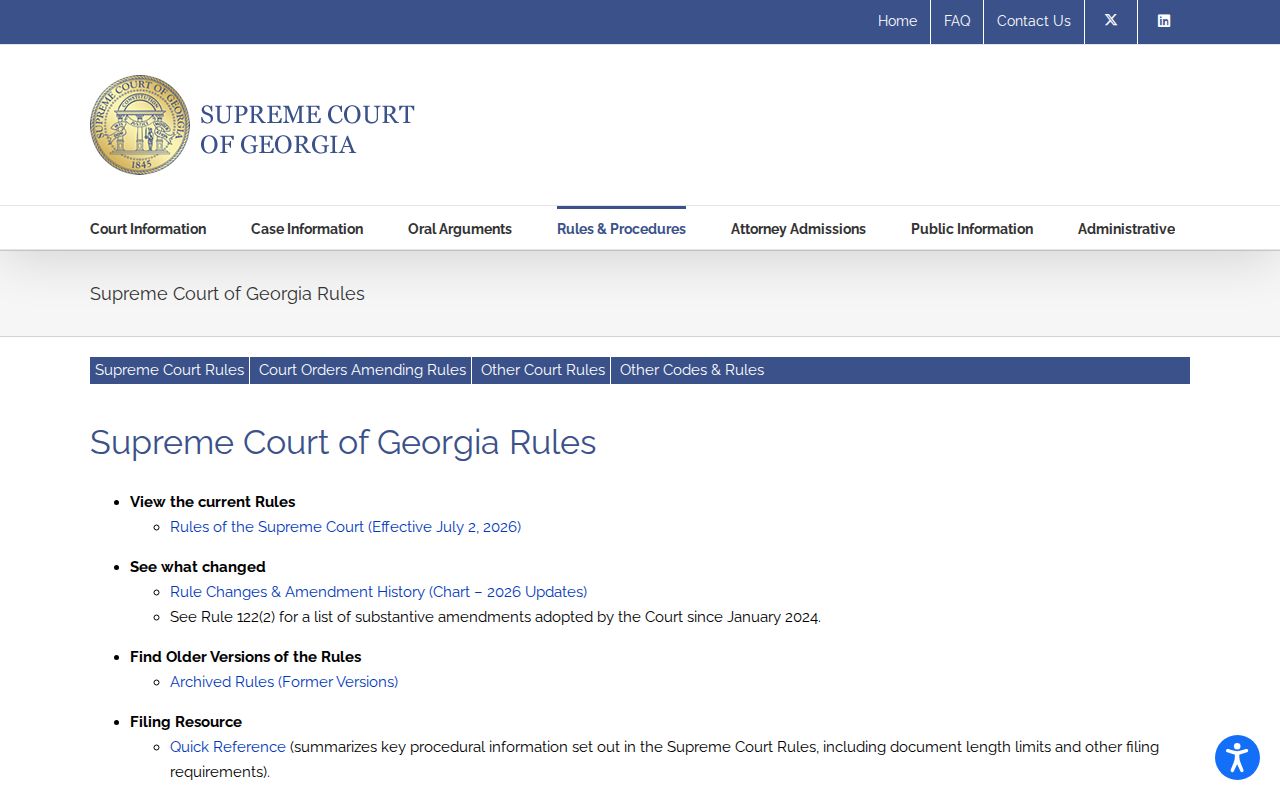
Those rules help explain why court access and sealing do not operate as ordinary executive-agency record requests.
Case Records at the County Level
The complete Georgia criminal case file stays with the clerk where the prosecution was filed. Online indexes may omit document images, older cases, or lower-court records. Contact the Superior Court clerk for felony files and the relevant State, Magistrate, Municipal, or Probate clerk for other matters. Ask for the docket and the signed disposition before ordering every page.
Georgia access may be online, by mail, at a public counter, or through a provider account. Georgia certified copies, archived retrieval, and document images can carry the clerk's quoted fee. Browse the directory of all 159 Georgia counties to reach the right local criminal-records site and find county-specific court routes.