
Georgia Arrest History
A Georgia arrest creates several records at once. The arresting Georgia sheriff, police department, State Patrol unit, campus force, or GBI team creates an agency report. A Georgia county jail may create a booking record, custody status, bond entry, photograph, and fingerprints. The Georgia court later creates its own docket if charges are filed. Each arrest record has a separate custodian and a different update cycle.
Reportable fingerprints and arrest data flow to the Georgia Bureau of Investigation's Georgia Crime Information Center, known as GCIC. GCIC links the event to state identifiers and later adds the disposition supplied by a court, prosecutor, or other justice agency. A county booking roster can be current while the Georgia criminal history still awaits a filed outcome. Neither source alone tells the whole story.
Four Georgia Arrest Record Channels
Use the Georgia source that created the arrest detail in question. The arresting agency holds its initial incident or arrest report. The Georgia county jail holds booking, bond, release, and current custody data. The Georgia clerk holds the prosecution docket and signed outcome. GCIC holds the compiled, identity-linked Georgia history, subject to state dissemination rules. These are parallel channels, not duplicate copies.
A request should include the agency case number, booking number, warrant number, court case number, or Georgia tracking identifiers when known. That helps separate people with similar names. Under the Georgia Open Records Act, an executive agency should respond within three business days, even if production takes longer. Active-investigation, juvenile, victim, medical, security, and personal-identifier data may be withheld or redacted.
Ask for electronic production when that format meets the need. Georgia guidance excludes the first 15 minutes of staff search time from retrieval charges, then permits actual time for the lowest-paid qualified worker and paper copies up to the stated per-page limit. A custodian should give a cost estimate and cite the legal basis for any denial or redaction.
Note: Georgia court records follow judicial access rules, while police and jail agency requests generally use the Open Records Act.
How Georgia Arrests Reach the Record
Georgia booking staff identify the person, record the reported charges and holds, take fingerprints when required, and create a custody record. The fingerprint submission gives GCIC a stronger identity link than a name alone. Georgia uses an Originating Tracking Number for the arrest cycle and charge tracking numbers for its parts. The Georgia court or prosecutor later reports the charge-level result so the compiled history can pair an accusation with its outcome.
Data flow: Arrest › Booking › Fingerprint Submission › GCIC Entry
Georgia reporting can lag or fail to match. A docket may show a final result before GCIC receives it. The reverse can also occur when an online Georgia clerk index has not posted the latest image. If a Georgia arrest history lacks a disposition, obtain the county judgment and ask the originating clerk or prosecutor to transmit the correction. GCIC cannot create a local disposition on its own.
Georgia Arrest Counts in Context
GCIC runs Georgia's Uniform Crime Reporting program under FBI definitions. The official 2024 summary recorded 30,934 Index Crime arrests, down from 31,574 in 2023. The 2024 total included 9,676 violent-index arrests and 21,258 property-index arrests. Those are reported arrest events, not a count of unique people. They also are not live jail admissions or court filings.
The report does not estimate incidents or arrests that agencies did not submit. Its 205,472 reported Index Crime offenses must not be treated as an arrest total. UCR is best for statewide trends, not for locating a person. The GBI crime statistics program provides reports and explains its limits.
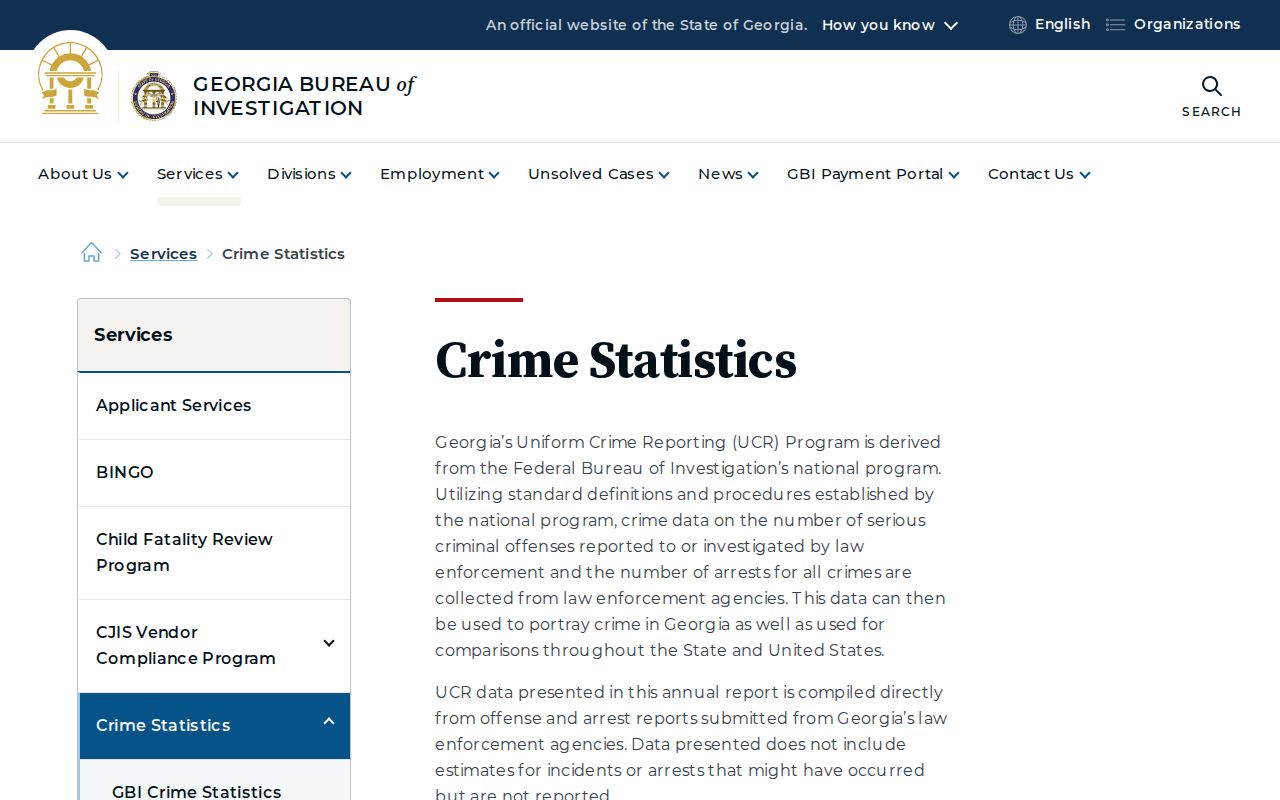
The program image identifies the official statistical channel while keeping person-level arrest searches with the proper custodians.
Looking Up Arrests in Georgia
No single public Georgia portal covers every recent booking and complete arrest history. Georgia Felon Search is not an arrest database. It returns only public final Georgia felony-conviction material and excludes misdemeanors, pending cases, restricted records, and mere arrests. For a recent Georgia arrest, start where the booking occurred. For one's own fuller Georgia history, use the personal local-agency or fingerprint-supported GCIC route.
- Identify the likely county, jail, and arresting agency. Check the sheriff's current or recent roster, or call booking if no roster exists.
- Request the initial arrest or incident report from the creating agency. Name the date, place, report number, and desired format.
- Use the directory of all 159 Georgia counties to find the local jail, sheriff, police, and clerk routes.
- Check the Georgia court docket for filed charges, bond events, and the final result. Use GDC or federal sources only when custody moved to those systems.
Note: Preserve the inspection date because Georgia booking, bond, release, and court filing status can change within hours.
Who Creates Georgia Arrest Records
A Georgia county sheriff may make an arrest, run the jail, serve warrants, and keep county booking data. A Georgia municipal police department keeps its own incident and arrest reports even when the person is booked into the county jail. Georgia State Patrol records go through the Department of Public Safety's open-records channel, with a separate route for eligible crash reports. GBI holds only records it created in assigned or requested investigations.
Send the request to the originating Georgia agency. A city police report does not become a GBI report because fingerprints reached GCIC. Likewise, the Georgia clerk cannot supply the officer's full investigative file. If the arrest is recent and missing online, call the booking jail, ask the arresting agency's custodian for the initial report, and check Magistrate or other likely Georgia courts for first-appearance and warrant-return entries.
Inside a Georgia Arrest Record
Georgia booking and arrest fields describe the event as first recorded. Charges can change after prosecutor review, and a roster may not show the result. Public copies can omit protected identifiers and sensitive details. Booking photos may be public in some settings, but online publication is not universal. Georgia law regulates commercial booking-photo practices, and no mugshots are republished here.
| Arrestee Name & Identifiers | Name, aliases, age or date data, sex, race, and physical descriptors where public. |
|---|---|
| Arrest Date & Location | When and where custody began, subject to redaction in protected cases. |
| Arresting Agency | The sheriff, police, State Patrol, GBI, or other authorized contributor. |
| Charges at Booking | Initial descriptions, codes, warrants, and level as known at intake. |
| Booking Number & Photo | The jail's event key and any lawfully released intake image. |
| Bond / Release Status | Bond type or amount, holds, release method, and current status when supplied. |
An official representative county roster shows how recent Georgia booking data can be presented.

Its short coverage window illustrates why one county roster cannot serve as a statewide Georgia arrest index.
Georgia Jail, GDC, and VINE
Georgia county jail and Georgia Department of Corrections custody are different. Georgia jails hold many people before trial and some local sentences. GDC holds state-sentenced people after conviction, commitment papers, and placement. The free GDC Offender Query can search by name, GDC ID, case number, description, and active or all status after a disclaimer is accepted.
Georgia VINE adds search and notification for participating custody agencies. Users can register for status alerts where offered, but urgent facts should still be verified with the jail or GDC. Federal custody is separate and requires the Bureau of Prisons locator. None of these custody systems proves the result of a Georgia prosecution. The court judgment remains the outcome source.
The Georgia VINELink portal is the official statewide custody-notification source.

The portal supports custody awareness without replacing the county booking record or Georgia court docket.
Restricting a Georgia Arrest Cycle
Georgia uses the term record restriction. It can hide qualifying charge information from ordinary noncriminal-justice dissemination, but it does not automatically destroy every local file. A separate court sealing process may be needed for clerk-held documents. Potentially qualifying outcomes can include dismissal, no further action, nolle prosequi, dead docket, acquittal, and other routes defined by Georgia law.
The procedure depends on the arrest date. For arrests before July 1, 2013, GBI provides a form that moves through the person, arresting agency, prosecutor, and GCIC. For later arrests, the request begins with the prosecutor responsible for the county and court. First obtain one's Georgia history and court disposition. Missing outcome data can delay restriction, so correct the source record first and then recheck both GCIC and the county docket.
Restriction is not automatic after dismissal or acquittal. The correct Georgia prosecutor and arrest cycle must be identified, and some forms of relief follow separate laws. Successful First Offender discharge, conditional discharge, and court sealing should not be treated as one process. Keep the final order or confirmation, then check each official source because a GCIC change does not rewrite every independent county record.
Note: A Georgia record restriction can limit dissemination without erasing the fact that an original arrest document was once created.
Arrests vs Convictions in Georgia
An arrest is an accusation and custody event. A conviction is a court judgment after a guilty plea or verdict. Georgia public systems reflect that split. A jail roster may show a booking before charges are formally filed. Georgia Felon Search may later show a final public felony conviction, but it will not show a mere arrest or misdemeanor. Always read the court result for each count.
| Arrest Record | Conviction Record | |
|---|---|---|
| Created by | Arresting agency and county jail | Court judgment reported to GCIC |
| What it proves | An arrest or booking occurred | Guilt was established by plea or verdict |
| Public access | Initial reports, rosters, and court filings, subject to limits | Court file and qualifying Georgia public felony products |
| Relief path | Record restriction and possible separate court sealing | Narrower, case-specific relief such as qualifying statutory paths |
Note: A Georgia arrest entry without a disposition is not proof of guilt; confirm the outcome in the county court case.
The Georgia criminal court case search is the right next step when a booking entry does not state how the charge ended.