
Checking Criminal History in Georgia
Start by naming the record needed. Georgia Felon Search answers a narrow question about public final Georgia felony convictions. A personal GCIC history gives the subject a broader view of reported Georgia cycles. County clerks hold prosecution files. County jails hold recent booking and custody data. The Georgia Department of Corrections covers state custody, and the Georgia Bureau of Investigation runs the public registry. No one result replaces the rest.
Gather the full name, date of birth, likely Georgia county, and an arrest or case number if known. A precise Georgia county and date often save more time than several loose name searches. Follow the source trail in this order:
- Use Georgia Felon Search when the question is a final in-state felony conviction.
- Enter the required name, birth date, and sex, then review the fee before buying a result.
- Open the county site for the case docket, booking, warrant, or local report.
- Compare identifiers and the final disposition. A similar name is not proof of identity.
- Use fingerprints and an official personal review when exact identity or a correction matters.
Note: A no-record Felon Search result does not rule out a misdemeanor, pending case, arrest, federal matter, or restricted record.
Georgia Felon Search Limits
Georgia Felon Search is the public face of one part of GCIC data. It can return a possible demographic match and a public rap sheet for final Georgia felony convictions. It does not return misdemeanors, juvenile history, restricted or sealed events, pending matters, federal cases, or records from other states. The charge is $15 for a search or rap sheet, even when the response says no record. Each partial-match record selected can trigger another $15 charge.
The official Georgia Felon Search interface shows the terms and payment path used for a public query.
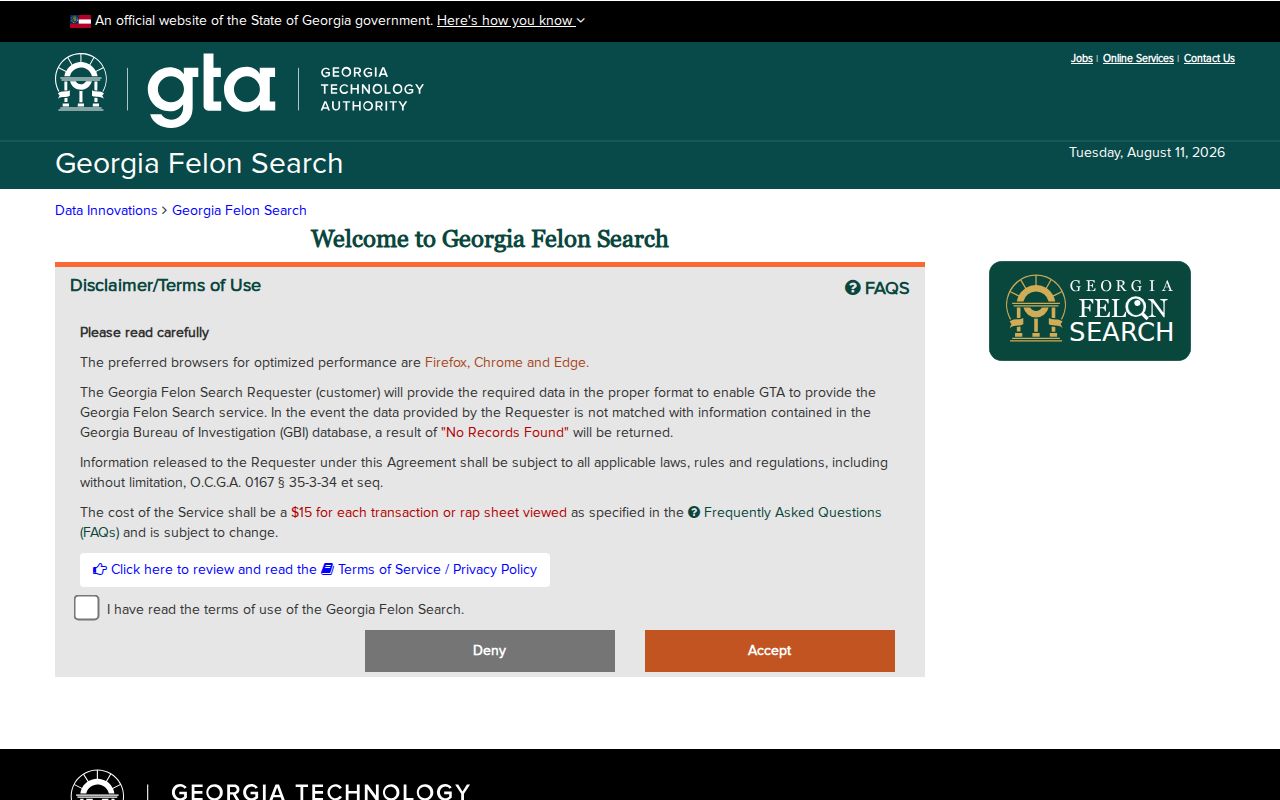
The screen reinforces why a paid Georgia name match should be checked against the county case and, for self-review, a fingerprint-supported Georgia record.
| Field | Required | Search Detail |
|---|---|---|
| First and last name | Yes | Middle name is optional and can narrow matches |
| Date of birth | Yes | Entered through month, day, and year controls |
| Sex | Yes | Used with demographic matching |
| Race or identifier | No | May reduce a broad set of possible matches |
| Email and requester | Portal flow | The response is sent to the supplied email |
Inside the Georgia Criminal History Repository
The Georgia Bureau of Investigation's Georgia Crime Information Center, known as GCIC, is the central repository and Georgia's CJIS connection. Computerized Criminal History links identifying data, reportable arrests, court outcomes, and Georgia correctional custody received from justice agencies. GCIC also supports fingerprints, Uniform Crime Reporting, the sex offender system, protective-order data, Rapid ID, and national exchanges. Its CCH system holds records on nearly four million offenders.
The Georgia public does not receive unrestricted access to that full network. Georgia Felon Search exposes only public final felony conviction data. A person reviewing a broader Georgia history uses a local sheriff or police identity process or GCIC's personal inspection route. The specialized Georgia GBI and GCIC records page compares those products, fees, and correction paths.
The official GCIC overview shows the range of systems housed in the division.
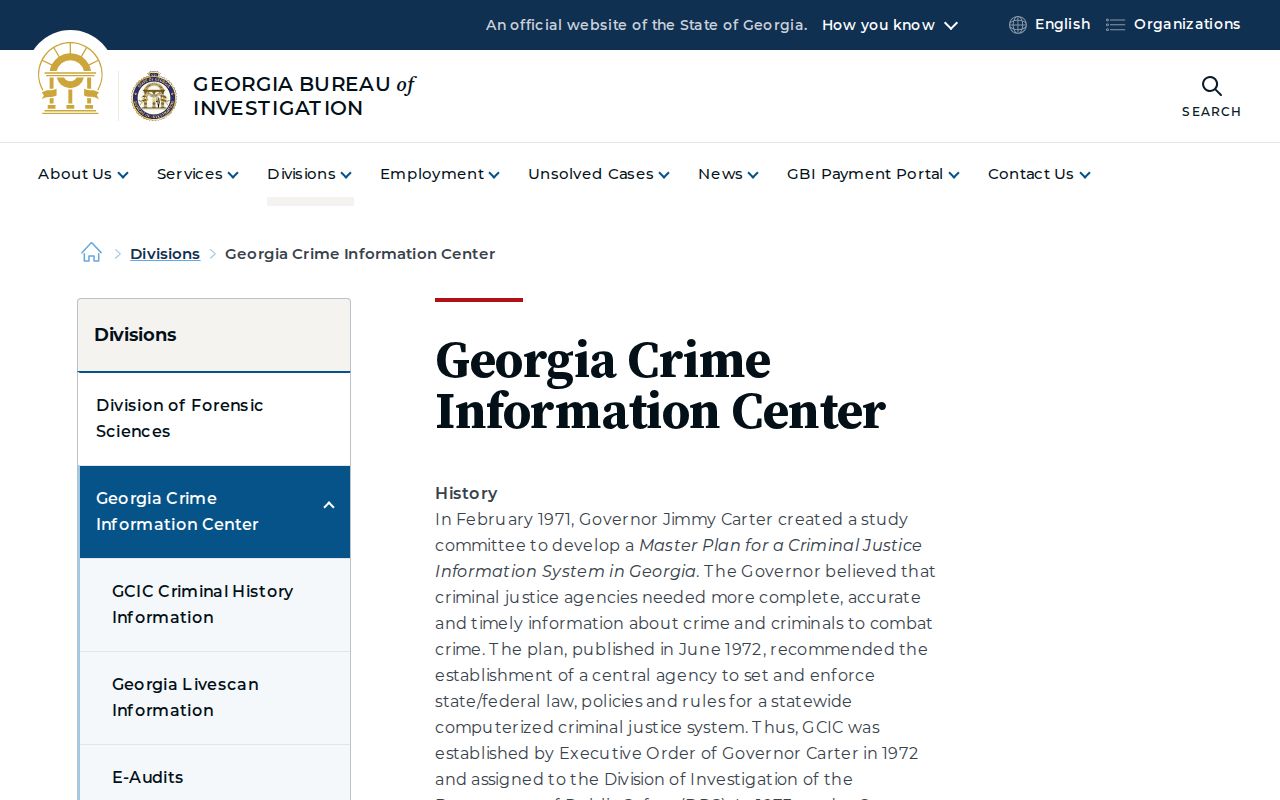
That broad role explains why a GCIC history is compiled evidence, while the source report and pleadings remain with local agencies.
Note: A Georgia GCIC entry summarizes reported data and does not replace the arresting agency's report or the clerk's signed order.
Georgia Records Start Locally
A reportable Georgia record begins with a local arrest and booking. GCIC Rule 140-2-.03 calls for submission of fingerprintable Georgia arrests within 24 hours, with an allowance for weekends and holidays. A successful fingerprint transaction creates an Originating Tracking Number. Charge Tracking Numbers identify charge lines. Georgia prosecutors and clerks then use those keys when they report the final result, generally within 30 days under the rule.
Arrest → Booking and fingerprints → OTN and charge tracking → County prosecution → Final disposition → GCIC history.
A missing Georgia result often reflects a broken link in that chain. The arrest may lack a matching disposition, an older paper file may not be online, or the clerk's update may still be in process. GCIC cannot invent the county outcome. The Georgia court or prosecutor that owns the official result must support and transmit a correction. This is why the compiled history and the original county file should be read together.
Georgia Statewide Record Systems
Georgia divides criminal records by function. GCIC compiles Georgia criminal history. The judicial branch supplies a gateway to participating Georgia court systems, but not one complete statewide docket. GDC tracks state correctional custody. The GBI registry publishes registration data supplied by sheriffs and state agencies. Each Georgia system answers a different question, and local records remain vital when statewide coverage is partial.
| System | What It Holds | Run By |
|---|---|---|
| Georgia Felon Search | Public final Georgia felony convictions | GBI / GCIC |
| GDC Find an Offender | State correctional identity, sentence, and location fields | Georgia Department of Corrections |
| Georgia Sex Offender Registry | Public profiles and reported registration data | GBI / GCIC with county sheriffs |
| Georgia Courts E-Access | Links to participating clerk and provider case systems | Judicial Council / AOC and courts |
Note: Georgia Courts E-Access is a gateway with partial participation, not a single complete statewide criminal-case database.
Georgia GAPS Fingerprint Checks
Georgia Applicant Processing Service is the authorized Georgia civil fingerprint channel. Since February 3, 2025, IdentoGO by IDEMIA has operated enrollment. The person first obtains the correct service code from the authorized agency, enters it at the Georgia portal, schedules a site, brings accepted identification, and submits electronic fingerprints. The Georgia response usually goes to the authorized requesting agency, not to a public user searching for someone else.
The Georgia GAPS and IdentoGO start screen begins with that required service code.
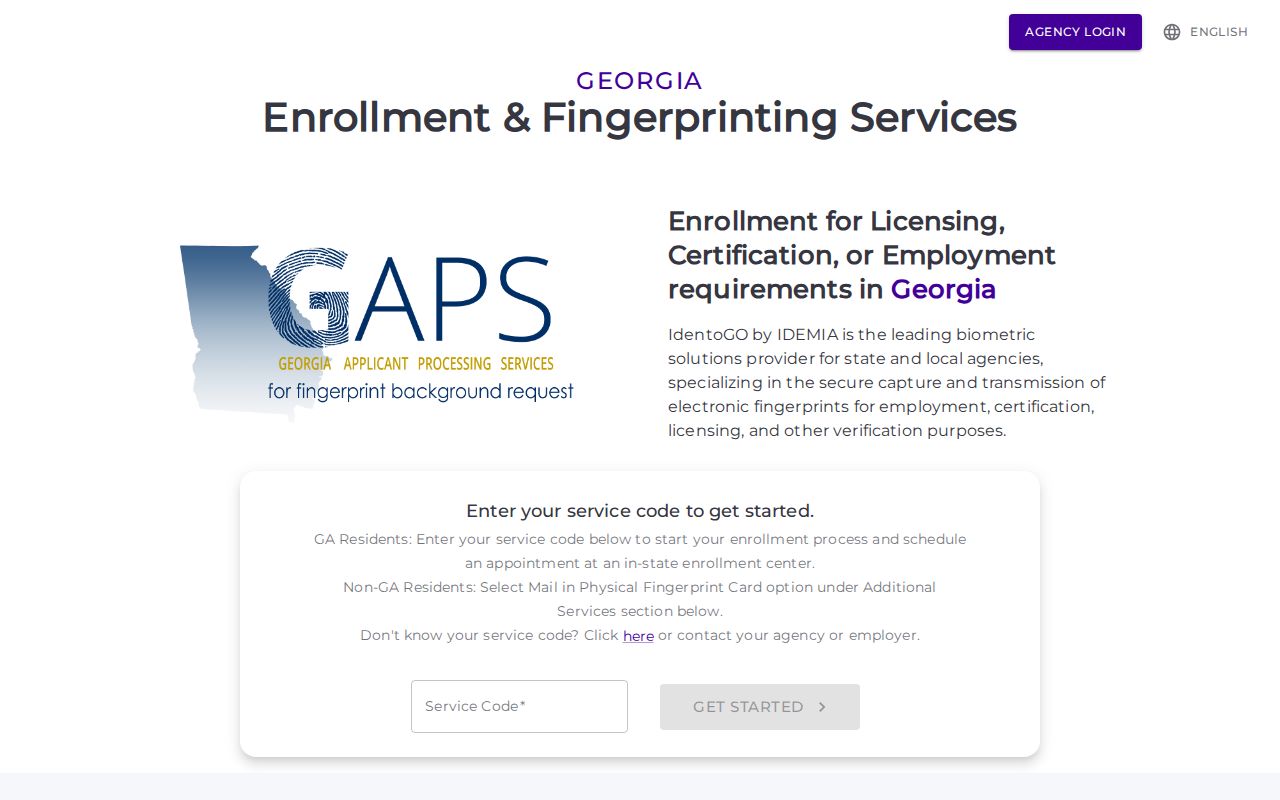
The gated start keeps GAPS distinct from Georgia Felon Search and from a person's separate GCIC inspection or challenge request.
Types of Georgia Criminal Records
The same event can create several Georgia records. Georgia police document the incident and arrest. A jail records booking and custody. A prosecutor and clerk build the Georgia case file. GCIC compiles reportable cycles and outcomes. GDC creates state sentence and custody data. DCS records adult felony supervision, while the Parole Board makes release decisions. The Georgia registry is a separate public safety system with its own duties and fields.
- Arrest and booking records: local agency files that show custody, alleged charges, bond, and booking data.
- Criminal court cases: dockets, filings, hearings, pleas, judgments, and sentence documents held by the proper clerk.
- GCIC histories: compiled identity, arrest-cycle, reported disposition, and correctional data available through lawful channels.
- Warrants: active justice information verified with the issuing court and law-enforcement agency, not one public statewide list.
- Custody and supervision: separate county jail, GDC, DCS, Parole Board, and VINELink records.
Georgia Jail, Prison, or Parole
A county jail record answers whether a person is held locally before trial, on a short sentence, or while awaiting state placement. GDC's Offender Query covers current and historical state correctional records, not a complete list of county detainees. Federal custody sits outside both layers. The GDC Facilities Division reports 34 Georgia state prisons. On August 7, 2026, GDC's Friday Report counted 49,924 people across state, transitional, county, and private facilities, plus a 2,497-person county-jail backlog awaiting state placement.
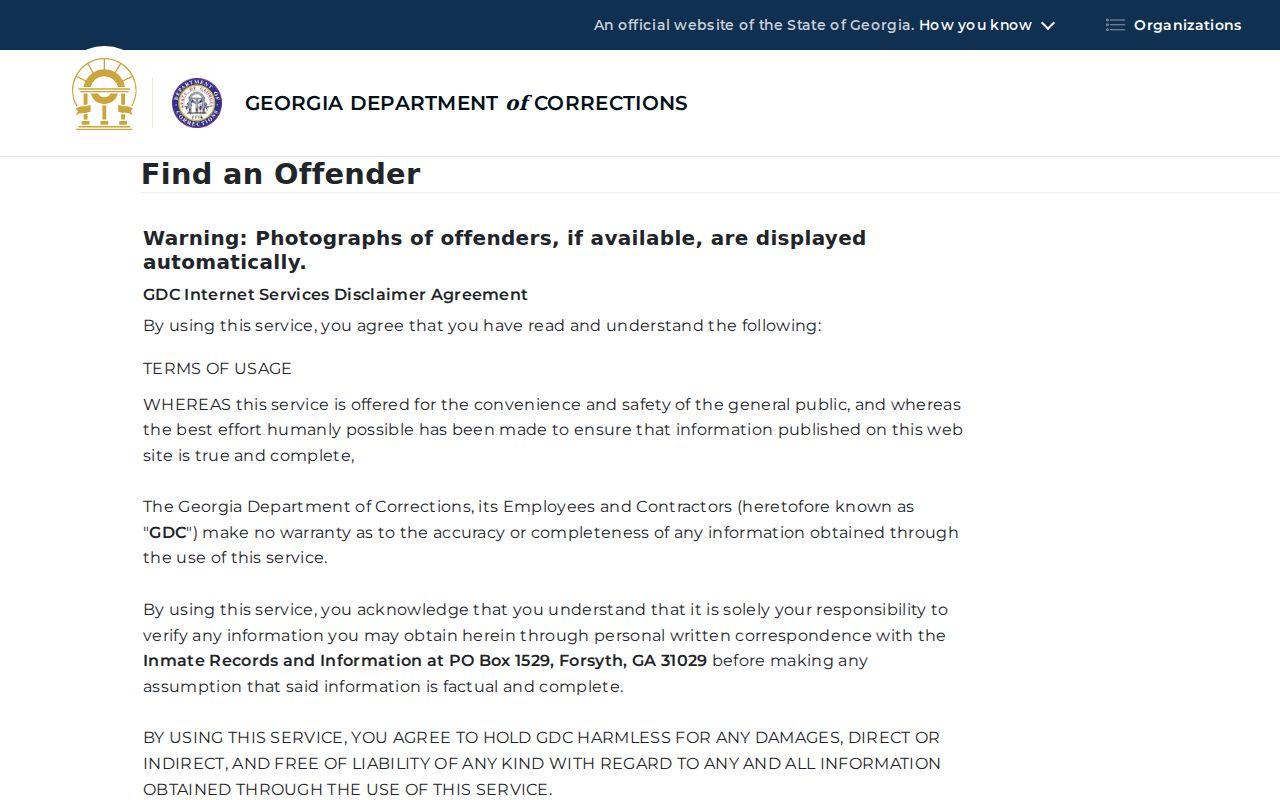
The GDC Find an Offender page explains the state locator and its verification limits.
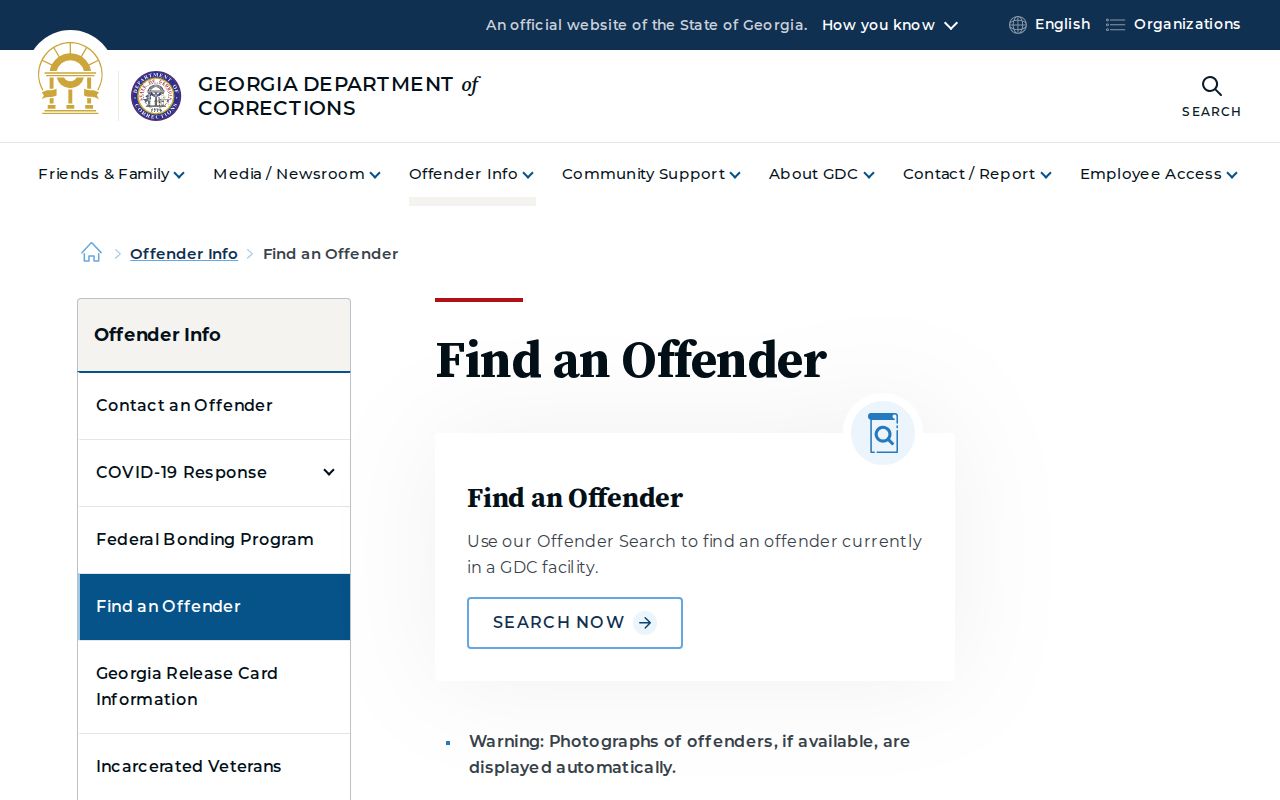
The live query separates active and inactive records and warns readers to verify data before relying on it.
The GDC Offender Query interface contains the actual name, ID, and status search controls.
For release status, use the Parole Board search; for adult felony field supervision, use the Department of Community Supervision.
Georgia Warrants and Police Reports
Georgia has no public statewide warrant search. Warrant data may move through law-enforcement networks, but a public check should go to the issuing court and the sheriff or police agency that can verify present status. A warrant allegation is not a conviction. Anyone addressing a possible warrant should seek direct official confirmation and legal advice before appearing at an office.
Police and incident reports also stay with the agency that made them. County sheriff reports, city police files, campus records, and State Patrol material use different custodians. The Georgia Open Records Act is the executive-agency fallback. A focused request should give the event date, place, report number if known, names, and the preferred electronic format. Active investigations, protected victim information, personal identifiers, and sensitive methods may be withheld or redacted.
Georgia Felony and Misdemeanor Labels
Georgia does not use a universal Class A, B, or C felony ladder. The offense statute supplies the prison range. A felony is an offense designated as such and may carry death, life, or more than 12 months of imprisonment. A misdemeanor generally carries up to 12 months, up to a $1,000 fine, or both. A high and aggravated misdemeanor can carry up to 12 months and a fine up to $5,000, subject to the specific law.
- Arrest cycle
- The linked fingerprints, charges, and later reported outcomes tied to one arrest event.
- Disposition
- The reported result of a charge, such as dismissal, plea, acquittal, or conviction.
- Rap sheet
- A compiled criminal-history presentation, not the county's original incident report or full court file.
- Record restriction
- A limit on noncriminal-justice dissemination of a qualifying Georgia event, not destruction of every source record.
Georgia Public Access Laws
The Georgia Open Records Act governs requests to executive agencies and favors public access, subject to exemptions. An agency generally must produce responsive records within three business days or describe when production is expected, what it may cost, and why any part is withheld. Judicial case records follow court access rules. Criminal-history dissemination has its own limits, so an open-record request does not unlock restricted GCIC data.
Key Georgia laws:
O.C.G.A. §§ 50-18-70 through 50-18-77 set the Open Records Act request, response, fee, and exemption framework.
O.C.G.A. § 35-3-37 governs restriction of qualifying criminal-history events and related correction procedures.
Georgia Administrative Code Chapter 140-2 sets GCIC reporting, access, registry, security, and audit rules.
O.C.G.A. § 42-1-12 establishes core Georgia registry duties and enforcement provisions.
Georgia Record Restriction Changes
Georgia calls the main criminal-history remedy record restriction. It limits dissemination to noncriminal-justice users but does not erase every government record. For arrests before July 1, 2013, an applicant may need the older agency, prosecutor, and GCIC form route. For later arrests, the request generally starts with the prosecutor. Court sealing is a separate step. A person should inspect the GCIC history and county docket after processing because each source can have a different status.
The GBI record restriction instructions identify the route and forms. A 2026 change also matters: HB 162 provides restriction of First Offender court files, dockets, and indices at discharge and lets some people discharged before July 1, 2026 petition the discharging court to seal those records. Relief still turns on the exact event and court order.
Note: Record restriction and court sealing are related Georgia remedies, but one does not automatically prove the other is complete.
Georgia Criminal Record Fees
State fees depend on the product. Georgia Felon Search charges for each transaction or viewed rap sheet. GAPS totals combine the current GCIC amount and vendor service. Personal inspection, fingerprinting, restriction processing, court copies, and open-record work follow separate schedules. County fees can vary, so confirm the quote before submitting a local request.
| Georgia Service | Current Base Fee |
|---|---|
| Georgia Felon Search | $15 per search or viewed rap sheet |
| Standard GAPS Georgia-only check | $39.99 total |
| Standard GAPS Georgia and FBI check | $51.99 total |
| GCIC personal inspection with own cards | $10 |
| GCIC inspection plus headquarters fingerprints | $25 total |
| Record restriction processing | $25 where applicable |
The schedule took effect January 1, 2025. Court copies, local histories, and agency media requests are priced by the office or provider that holds the material.
Note: Confirm a Georgia fee before paying because county charges and vendor totals can change after a statewide schedule is published.
Georgia Supervision Records Split
Georgia separates sentence, release, and supervision functions. GDC records the state sentence and custody. The State Board of Pardons and Paroles makes parole decisions. The Georgia Department of Community Supervision manages adult felony probation and parole in statewide districts and field offices. Misdemeanor probation may instead be run by a county, municipality, consolidated government, or private provider under the sentencing court.
The Georgia Department of Community Supervision publishes statewide office and program information.
The agency view must be paired with the sentencing court for the signed probation order and with the Parole Board for release status.
The GDC Friday Report provides a dated view across custody and supervision systems.
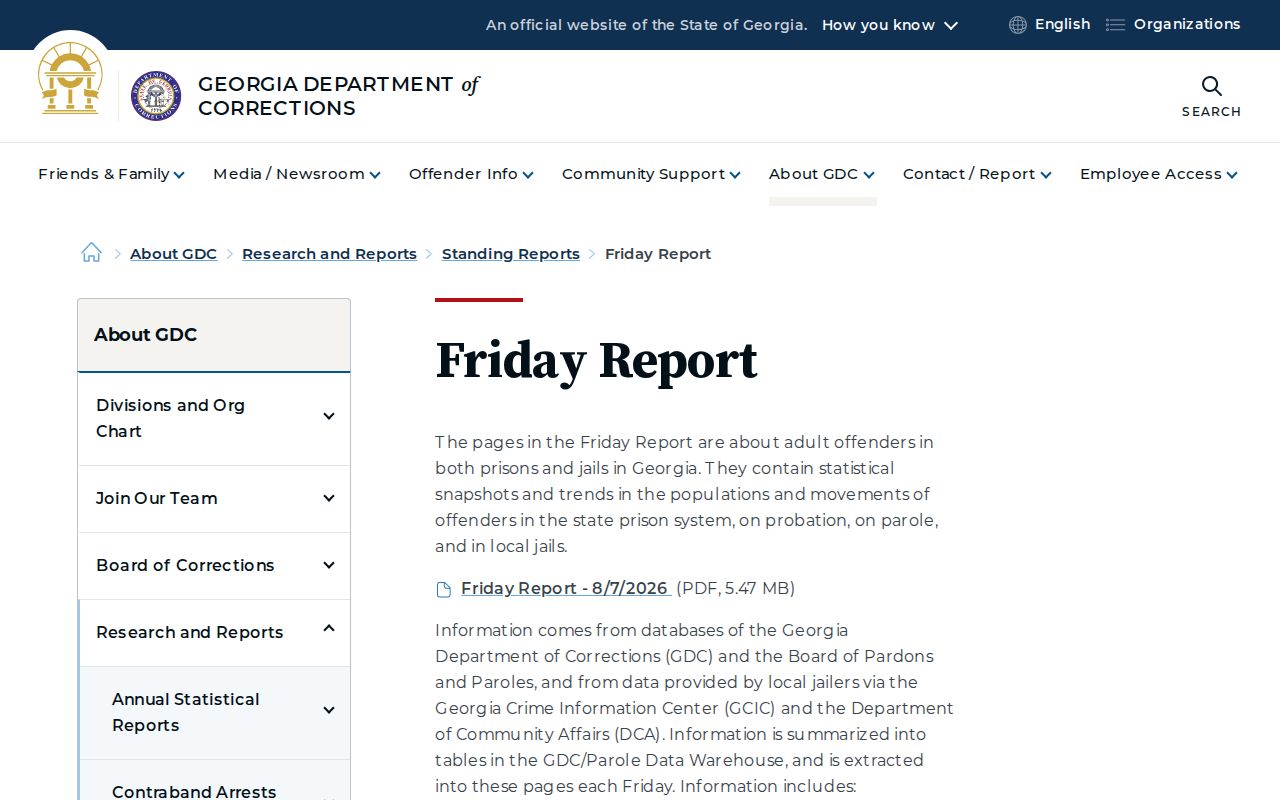
Because those totals change each week, every population figure should retain its report date.
Criminal Records by County in Georgia
Arrests, bookings, incident reports, warrants, and most case documents begin in one of Georgia's 159 counties. The county layer is therefore essential even when a statewide record exists. The large metro systems below illustrate the range of sheriff, jail, Superior Court, State Court, and clerk channels. Each card opens the matching county criminal-records site.
Fulton County
Atlanta · Georgia's largest metro court and law-enforcement ecosystem
Gwinnett County
Lawrenceville · Large suburban court and jail-record network
Cobb County
Marietta · Major metro sheriff, courts, and booking channels
DeKalb County
Decatur · Distinct metro court and sheriff systems
Chatham County
Savannah · Coastal metro courts and recent-booking access
Clayton County
Jonesboro · High-volume south-metro court and jail channels
Cherokee County
Canton · Fast-growing north-metro local record systems
Forsyth County
Cumming · Local court coverage beyond the statewide gateway
The Georgia DCA county resources support the county-seat and population context used for the directory.
The complete A-Z list follows the live county folder roster rather than a partial list of metro jurisdictions.
Browse the full directory of all 159 Georgia counties to open the criminal records site for any county.